
Angela Duckworth’s research on GRIT reveals why passion and perseverance – not talent –predict workplace success. As baby boomers retire and younger workers enter with lower grit, engagement drops, and retention challenges intensify. Learn why retaining your best employees matters more than ever.
Imagine If CFOs Measured the Cost of Turnover
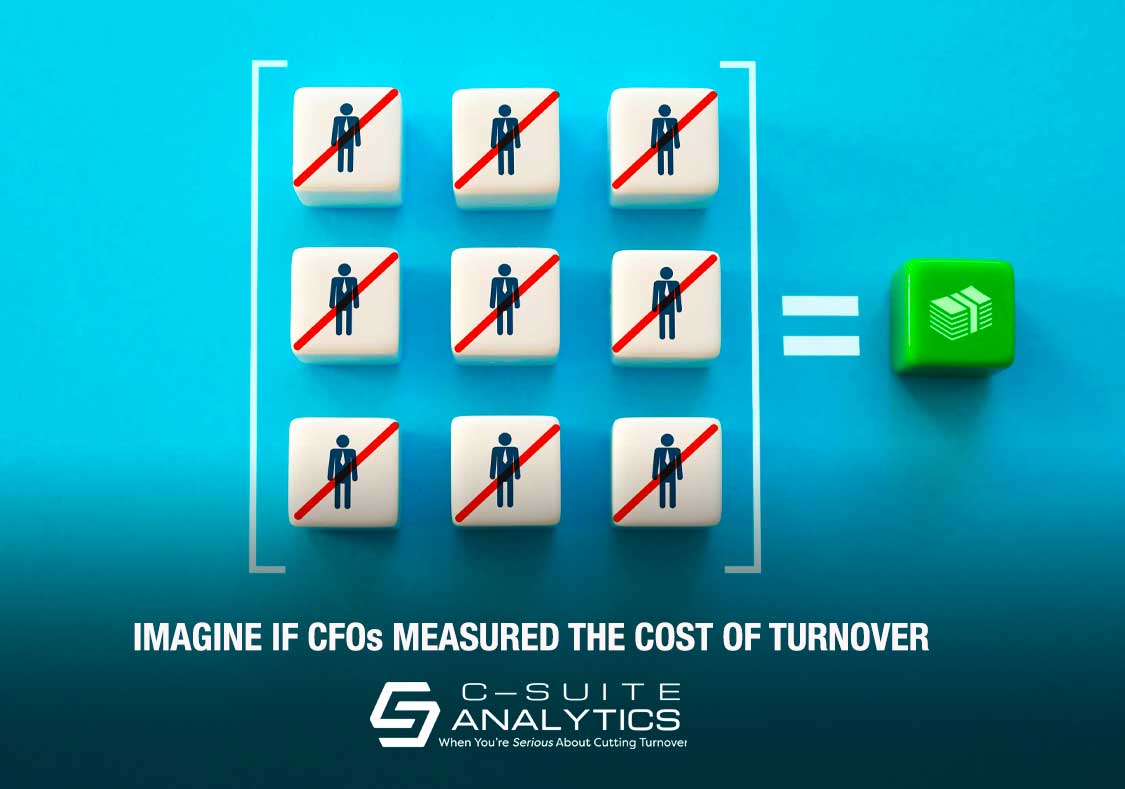
To quote John Lennon’s song, “You may say I’m a dreamer, but I’m not the only one.” Even though maybe I am the only one who supports this idea for now.
Business is essentially about money, and chief financial officers, or CFOs, are the money people. They count it, they record it, they lead the charge to set budgetary goals for it, and most importantly they are the voice that CEOs hear the loudest.
Why are CFOs Missing When it Comes to Turnover Reporting?
So CFOs turn their screens on each morning with one objective which is to find the coins in the couch. How can we squeeze out another cost reduction for another gain in profits? They then follow the training they received in business school so they all essentially track their business blueprints the same way.
In my new book, Targeting Turnover, I report on the complete absence of CFOs participating in turnover reporting in this way:
Generally Accepted Accounting Principles (GAAP) are standards that public companies in the United States must follow when reporting their financial information. Googling “GAAP and employee turnover” yields a few studies on the cost of losing a CEO or CFO, but nothing on the impact of total employee turnover on other key business metrics. It’s as though turnover doesn’t really exist in our organizations, that there is no presence for it on accounting’s screens. Yet Gallup estimates the cost of voluntary turnover to American businesses is a staggering one trillion dollars…every year.[i]
——
Further reading: When Non-HR Executives Ask About Turnover (Again)
——
Full Participation Ensures Agreement on Cost of Losing One Employee
Our first step with new clients is to apply our proprietary turnover algorithm to identify dollar costs for turnover for important jobs…and we require finance to participate. The resulting number will never be 100% accurate because there are too many variables, too many moving parts…but we will ultimately agree to a number that represents the cost of losing one employee in a particular job. Here are a few examples:
- Nurse: $42,131
- Truck loader/unloader: $4,955
- Call center representative: $29,447
- Physician: $225,808
- Truck driver: $21,221
- Software engineer: $131,290
- Forklift driver: $10,742
- Manufacturing entry-level: $5,518
These costs are based in part on company-specific data including revenue-per-employee, the days these jobs remain open, and the ramp-up time for each new hire, so these companies’ costs that as indicated above might not the be same as for your company.
——
Further reading: Turnover’s Biggest Price Tag Isn’t Recruiting – It’s Lost Productivity
——
There are Many Reasons to Calculate Your Cost of Turnover
This is just one of the reasons why you should calculate your own cost of turnover, and another reason is to include your executives so they actually act on the results. An aerospace company’s CFO’s reaction was like no other. He reluctantly joined in to participate in the calculation and ultimately agreed to the cost for losing an engineer to be $121,500. He called me the next morning to say he couldn’t sleep, went to work very early, and with some extrapolation discovered that his company’s turnover cost was their second-highest cost…placing that cost ahead of the properties and materials required for his company to build rockets.
My book also details how to determine turnover’s cost for all jobs, such that your company can develop reporting month-to-month for not only employee retention’s performance against goals but also against a pre-determined standard to reduce the full costs associated with employee turnover.
—–
Check out our free Turnover Cost Calculator
—–
The Cost of Turnover Playbook for CFOs
If you need a playbook for costing your turnover, see my new book Targeting Turnover: Making Managers Accountable to Win the Workforce Crisis. It connects the dots from workforce math to line-leader accountability, with the how-to for embedding Stay Interviews and Finnegan’s Arrow.
Available in e-book, audio, and paperback wherever books are sold – including Amazon, Barnes & Noble, and BookPal for group sales.
[i] Shane McFeely and Ben Wigert, “This Fixable Problem Costs US Businesses $1 Trillion,” Gallup Press, March 13, 2019; https://www.gallup.com/workplace/247391/fixable-problem-costs-businesses-trillion.aspx

Related Posts