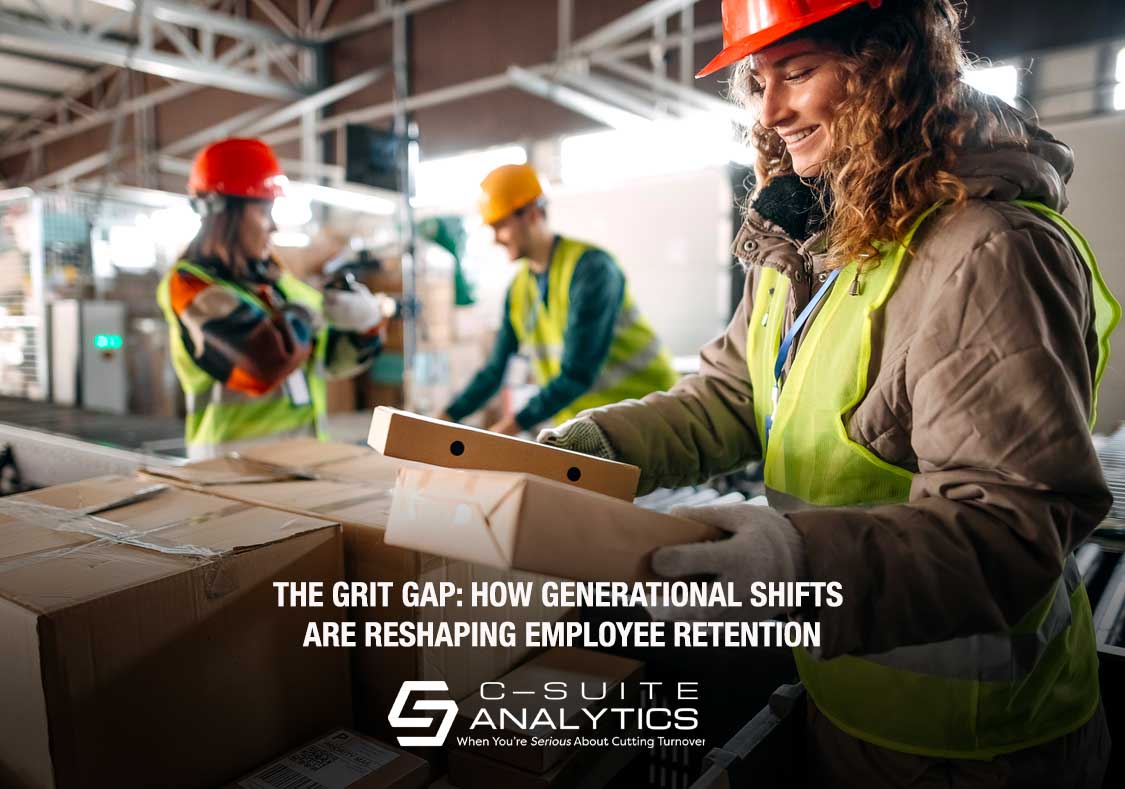
Angela Duckworth’s research on GRIT reveals why passion and perseverance – not talent –predict workplace success. As baby boomers retire and younger workers enter with lower grit, engagement drops, and retention challenges intensify. Learn why retaining your best employees matters more than ever.
Two Ways to Cut Turnover. Only One Will Always Work.

A One-Question Quiz on Turnover
Here’s a simple quiz with two possible answers – one right and one very, very wrong.
The wrong answer comes from “best practices.” The right one comes from science.
The Problem with “Best Practices”
What exactly are “best practices,” anyway? For decades I’ve read articles titled “5 Ways to Cut Turnover” or “10 Engagement Hacks.” The ideas always come from the same grab bag: recognize good performance, build career ladders, hold more town halls, add a new benefit.
The problem? These articles rarely, if ever, cite actual evidence. You never see: “By recognizing good performance, Company X cut turnover by 15%.”
“Best practices” are generic. They sound good. They spread fast. But there’s no proof they work.
What Science Tells Us
Science, on the other hand, gave us electricity, airplanes, and luggage with wheels – big changes that reshaped daily life. Science has also given us decades of research on why employees stay or quit. And it all points in one direction.
——
Further Reading: Exit Interviews – More Like Autopsies or Toe Tags?
——
Two Answers to the Quiz
Answer #1 (Wrong): The best way to cut turnover is to roll out one-size-fits-all programs.
That’s the path of most companies:
- Run engagement or exit surveys.
- Form a committee.
- Launch recognition programs, raise pay, or add benefits.
It’s a cycle – survey, program, disappointment, repeat. Employers keep doing it even as quits remain at historic highs.
Answer #2 (Right): The best way to cut turnover is to drive retention through each leader, teaching them to build one-on-one trust with every employee.
That’s not an opinion – it’s science. More than 25 studies confirm the same truth:
- The #1 reason employees stay or leave is how much they trust their immediate supervisor.
- Gallup tells us 70% of an employee’s engagement comes from their relationship with their boss.
- Kenexa found employees’ opinions of supervisors’ influence how they view pay, benefits, advancement, and development.
Supervisors – not programs – are the lever. If you want retention, build trust.
Why Companies Stick with the Wrong Answer
So why do most organizations still chase one-size-fits-all fixes? Because they’re easier, and they’re all leaders know. It’s simpler to roll out a new program than to do the hard work of developing every manager. But simple doesn’t solve the problem.
——
Further Reading: Why Stay Interviews Outlast Every Engagement Trend
——
The Results When You Choose Science
Since the so-called “Great Resignation” began in 2021, the workforce crisis has only deepened. Baby Boomers are retiring in record numbers, Gen Z is the smallest generation yet, and every forecast says the same thing: employers will run out of workers before they run out of work.
That’s why turnover savings today matter more than ever. Consider what happens when organizations stop chasing programs and instead develop leaders to build trust:
- A major healthcare system reduced turnover 58%, saving $6.9 million.
- A food processing company cut turnover 49%, saving $2.3 million.
- A waste collection company slashed turnover 30% at one location, saving $240,000, then scaled the solution through train-the-trainer.
These aren’t abstract percentages. These are dollars reclaimed in industries where frontline workers are hardest to find and hardest to replace. And they prove a single point: trust between supervisors and employees isn’t just a “nice to have” – it’s the only lever that consistently drives retention results.
The Takeaway
In 2025, there are still two ways to cut turnover.
You can keep launching one-size-fits-all programs, watching quits climb, and wondering why nothing changes.
Or you can equip leaders to build trust with every employee – and see turnover finally fall.
That’s the argument I lay out in my new book, Targeting Turnover: Making Managers Accountable to Win the Workforce Crisis. It’s built on science, sharpened by results like these, and designed to help organizations finally solve retention where it matters most: through every leader, one employee at a time.
Dick Finnegan’s new book, Targeting Turnover: Making Managers Accountable to Win the Workforce Crisis, publishes this September. Pre-order your copy now to get ahead of the looming workforce retention challenge. Want to purchase 25 copies or more for your team? Visit the bookpal bulk order page for a significant discount – 38% and more!
Related Posts