
Angela Duckworth’s research on GRIT reveals why passion and perseverance – not talent –predict workplace success. As baby boomers retire and younger workers enter with lower grit, engagement drops, and retention challenges intensify. Learn why retaining your best employees matters more than ever.
The Workforce Crisis Just Got Worse: Immigration, Retention & The Future of Work
Fall is in the air, as are football and the universally-favorite visual of trees-turning-to-orange beginning in October. What is also in the air is that we are running out of workers, even though our daily economic data provides a very short-term respite from this most-important-of-all economic worry.
The US economy has stalled, though that news is sometimes shielded by the significant major stock market gains that impact the relatively few. Inflation is up, hiring is down, and companies are sitting on the sidelines rather than aggressively chasing growth, all wondering where administration decisions are heading regarding immigration and tariffs.
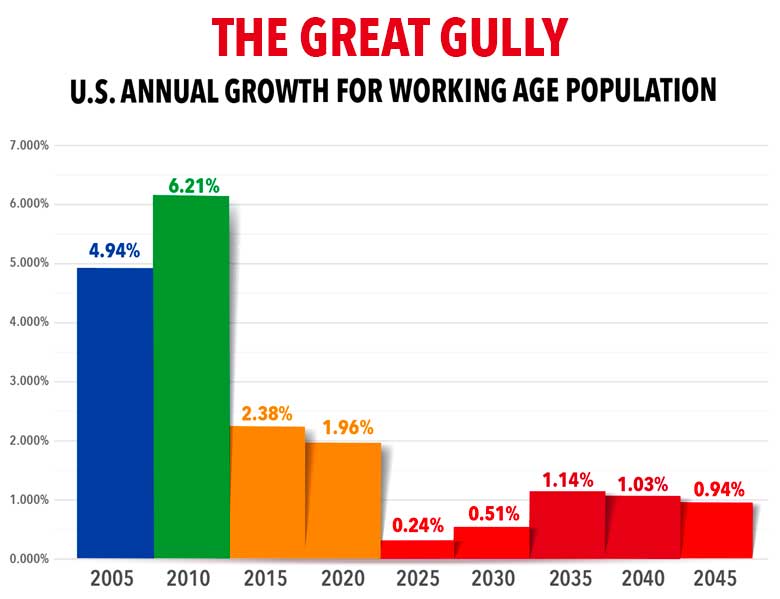
Chapter one of my new book, Targeting Turnover, now available in e-book, audio, and paperback wherever books are sold including Amazon, Barnes & Noble, and BookPal, has received broad acclaim for reporting hard data on how the near-future economies of all first-world countries will depend 100% on their success at immigrating the most and the best-qualified. Quotes from that chapter and the included “Great Gully” chart regarding our actual number of future workers include the following:
- Over thirty million Americans will reach retirement age between 2024 and 2030, representing nearly 20 percent of our total workforce.
- For the first time in our history, older adults will out-number children by 2034.
- The U.S. population will begin to decrease in 2080, while the number of working-age Americans will decrease before then.
- As we progress deeper into this century, the race will be on for developed nations as they compete with each other for immigrant talent.
- Can the United States maintain its global economic dominance in the next twenty years and beyond while our number of working-age citizens remains relatively flat?
And then this direct quote from the U.S. Census Bureau: “Beginning in 2030, immigration is projected to overtake natural increase (the excess of births over deaths) as the primary driver of population growth for our country.”
—–
Further Reading: One Reason the US Added Only 73,000 Jobs in July: Immigration
——
The New Reality Is More Bleak
But this week comes a report from Axios with an alarming title: Without Immigration, U.S. Population Could Start to Decline As Early As 2031.[i]
The report tells us that updated analyses from our government’s Congressional Budget Office says the U.S. population will be smaller and grow more slowly than previously projected, “a result of the Trump administration’s crackdown on immigration.” Note that the source of this report is from inside our own government, our own current administration.
This weekly Targeting Turnover column is never intended to drift into politics but instead focuses on the skinny topic of how to retain the workers we want to keep…but in this case this major subject of immigration policy has a major impact on our actual number of future workers.
The Axios report continues to tell us that the CBO now projects 290,000 immigrants will be “removed” from our country and another 30,000 will leave voluntarily…and also that deaths will begin exceeding births in 2031 which is two years than earlier projections, again related to this current immigration crackdown.
How One Policy Decision Impacts Another
I’d like to say that our government is making a policy decision, that reducing immigration is seen as more important than growing our economy and helping individual businesses thrive. But I’m not certain they understand how one set of decisions will impact the other.
In the meantime, the number of foreign students attending US colleges is down by 40%[ii], and various reports tell us that fewer foreigners applied to enter the US during the first Trump administration.
Yet surprisingly, Americans have done a complete flip-flop in recent months regarding their immigration opinions. A year ago, 55% of Americans wanted less immigration and just 16% wanted more. But today a full 79% of Americans say immigration is a good thing.[iii]
—–
Further Reading: Without Immigrants, U.S. Working-Age Population Would Shrink
——
What is an Immigrant, Anyhow?
One thing clear is that Americans and maybe other world citizens are having trouble identifying what “immigrant” really means. Most debates center on legal status with little discussion about another group we refer to as refugees, while those of us interested in workforce only know that there are not and will never be enough native Americans to fill our jobs and drive our economy forward.
How This Impacts Your Company
Let me venture forward with this extreme statement:
Never in the history of the United States nor in the history of our world has retaining your top employees mattered more.
The math is clear. US births have consistently decreased since 1955…that’s 70 years…and we fell below the replacement rate way back in 1972. Then baby boomers, our largest generational group, are now removing 30 million grit-committed employees from our workforce. Our production future is in the hands of those who weren’t born here, and they have scores of countries to move to. And too many of them are choosing those countries over ours.
Ready to face the workforce crisis head-on?
Get your copy of Targeting Turnover: Making Managers Accountable to Win the Workforce Crisis today. Available in e-book, audio, and paperback wherever books are sold — including Amazon, Barnes & Noble, and BookPal for group sales.
[i] https://www.axios.com/2025/09/10/trump-ice-big-beautiful-bill-immigration
[ii] https://theconversation.com/fewer-international-students-are-coming-to-the-us-costing-universities-and-communities-that-benefit-from-these-visitors-264012
[iii] https://www.pbs.org/newshour/politics/poll-shows-how-u-s-views-of-immigration-have-changed-since-trump-took-office
Related Posts