
Angela Duckworth’s research on GRIT reveals why passion and perseverance – not talent –predict workplace success. As baby boomers retire and younger workers enter with lower grit, engagement drops, and retention challenges intensify. Learn why retaining your best employees matters more than ever.
The Missing Piece to Reduce Teacher Turnover

Borrowing a word from Sir John Lennon, let’s imagine how much better our world would be if we greatly reduced teacher turnover.
Now let’s imagine it’s October, and 24 second-graders are about to meet their third teacher for this same school year. Their original teacher left just before his students arrived, and the replacement lasted six weeks before deciding that teaching “wasn’t for her.” Now these 24 children, already struggling with major disruption, must build trust with a third educator while trying to master reading and math.
This story isn’t unique. Across hallways in schools nationwide, similar scenes unfold daily that leave students confused, parents frustrated, and remaining teachers stretched thin as they cover extra duties and mentor replacement after replacement.
Most of our readers don’t work in schools but many of you have children there, or you have clear memories of returning to school in the fall to a slate of new faces.
The Crisis Behind the Classroom Door
A few statistics paint the devastating picture of our education system’s instability. The U.S. faces a shortage of over 400,000 teachers, with many positions filled by educators lacking proper certification. Even more alarming is that 90% of teacher turnover results in educators leaving the profession entirely¹. These aren’t just career changes though, as they represent thousands of professionals abandoning years of preparation and student loan debt, concluding that teaching has been an unsustainable profession for them.
Thinking more broadly, research consistently shows that teacher turnover negatively impacts student achievement, school climate, and the professional learning communities that drive educational excellence. When experienced teachers leave, they take with them institutional knowledge, established relationships with families, and the deep understanding of their students’ individual learning needs.
——
Further reading – SHRM25: Engagement “Solutions” Are Failures, Do This Instead
——
Why Well-Intentioned Solutions Fall Short
Educational leaders and policy experts have identified numerous strategies to address teacher retention. A quick search reveals these thoughtful recommendations from respected organizations:
- The Learning Policy Institute suggests raising pay, providing mentors, offering targeted financial incentives, and establishing teacher residency programs².
- Panorama Education recommends collaborative problem-solving, recognition programs, self-care support, peer observations, and shared vision development³.
- TNTP (The New Teacher Project) emphasizes regular positive feedback, recognizing high performers, and encouraging commitment to staying at the same school⁴.
- American University’s research highlights mentorship, increased compensation, improved teaching conditions, positive school climate monitoring, and autonomy with professional growth opportunities⁵.
These are all evidence-based, valuable strategies. Yet despite widespread awareness of these approaches, teacher turnover continues to devastate schools nationwide. The missing element isn’t knowledge of what works – it’s consistent implementation driven by clear accountability and genuine relationships between teachers and their school leaders.
The Missing Piece: Accountability Plus Authentic Relationships
We’ve applied our Finnegan’s ArrowTM model to reduce employee turnover very successfully to companies in healthcare, manufacturing, food processing, and more, reducing turnover by an average of 34%…and saving companies millions of dollars. I developed the model’s core components at mid-career with the help of professor who opened my mind to employee retention’s leading research which taught me this:
The #1 reason employees stay or leave…or engage or disengage…
is how much they trust their immediate supervisors.
Gallup’s research says the same, that supervisor’s impact more than 50% of the reasons why employees stay or quit and up to 70% of why they engage or don’t engage in their work.
This insight led to the development of the Finnegan’s ArrowTM model, which we successfully applied to Osceola County Schools in Florida – a district serving Walt Disney World and extending into diverse communities with varying socioeconomic levels.
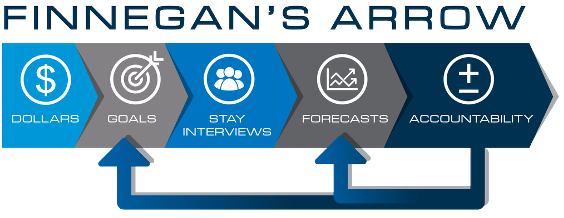
The model focuses on five critical components:
- Dollars indicates the importance of converting turnover percentages to dollars in order to gain top executives’ attention.
- Goals directs organizations to establish retention goals and identify who should be accountable for achieving those goals, beginning with first-line supervisors.
- Stay Interviews are the one-on-one structured sessions those leaders then facilitate with each member of their teams to identify why that employee stays, might leave, and what that leader can do to keep them, resulting in a written stay plan for each employee who needs one. These are structured retention sessions that result in a stay plan as opposed to “employee rounding”, “check-ins”, or other nonstructured drive-by interactions.
- Forecasts direct those same leaders to then predict how long each employee will stay.
- Accountability then relates to both goals and forecasts, as executives track how effectively each leader achieves their retention goals and also their forecast accuracy for employees who leave.
Osceola County: When Accountability Met Authentic Care
In August 2017, Osceola County’s forward-thinking superintendent gathered 75 principals and assistant principals for an intensive professional learning session. She began by presenting the district’s turnover data – not just percentages but the real impact on students, families, and school communities. Then came the paradigm shift: each principal-assistant principal team would be held accountable for achieving specific teacher retention goals.
My job, then, was to teach this group how to conduct Stay Interviews, a concept I invented with a top-selling book in 2012, explaining the five heavily-researched questions and facilitating exercises such that the participants learned to ask, listen, probe, take notes, and take responsibility for what they heard…rather than duck away and point elsewhere. And most importantly, they learned to develop customized, one-on-one retention plans for each of their teachers.
——
Further reading – Stay Interviews Really Work: Two Proven Retention Wins
——
Our Inspiring, Productive Beginning…
Within the first few months of implementation, teacher retention exceeded district goals. Principals reported that the Stay Interview process fundamentally changed their relationships with teachers. Instead of superficial interactions focused on compliance and administrative tasks, those principals and their individual teachers engaged in meaningful conversations about classroom support, career growth, and other topics that caused teachers to build upstream trust.
As one principal noted, “I learned that our retention challenges weren’t primarily about pay or resources – they were about teachers feeling unsupported and undervalued. When I started having regular, structured conversations about their needs, everything changed.”
The success stemmed from two critical factors: First, principals developed authentic professional relationships with each teacher through the structured Stay Interview process. Second, those principals took ownership of individualized retention plans because they were being held accountable for measurable retention outcomes.
…Was Then Interrupted by a Hurricane
The term “butterfly effect” is broadly defined as how circumstances in one area can lead to surprising changes in another area. Unfortunately, Hurricane Maria’s devastation of Puerto Rico and the resulting months-long power outages created several unexpected challenges in Osceola County schools. Thousands of families immediately relocated to live with relatives throughout central Florida, driving massive enrollment increases that required emergency classroom additions, teacher reassignments, and other reactions to this crisis, causing our retention initiative to slip down on the priority list.
Yet even during this chaotic period, the relationships built through Stay Interviews provided unexpected benefits. Principals reported that teachers who might have left due to increased stress and changing assignments stayed because of the authentic connections and support systems established through the retention process. The investment in relationships proved its value even under extraordinary circumstances.
Beyond Nice-to-Do: Making Retention a Leadership Priority
Educational leaders demonstrate extraordinary dedication daily. They enter the profession knowing compensation is modest and resources are limited, often purchasing classroom supplies with their own personal funds.
What educators cannot create, however, is additional time. The Finnegan’s Arrow model transforms teacher retention from a nice-to-do initiative into a structured leadership priority with clear expectations and measurable outcomes.
Consider the difference between a general statement like “provide positive feedback” versus scheduling periodic Stay Interviews where principals ask five specific questions, document concerns, and develop action plans for retention. The first approach depends on good intentions and available time whereas the second creates systematic relationship-building with accountability for results.
Returning to Sir John, you may say I’m a dreamer, but I’m not the only one. Let’s move forward together to not just improve teacher retention but to make America and the world a far better place to learn, live, and find true happiness.
Ready to Make Stay Interviews a Part of Your Retention Plan?
Email me at DFinnegan@C-SuiteAnalytics.com and let’s figure out how to implement Stay Interviews to start reducing turnover by 30% or more this year.
Dick Finnegan’s new book, Targeting Turnover: Making Managers Accountable to Win the Workforce Crisis, publishes this September. Pre-order your copy now to get ahead of the looming workforce retention challenge.
¹ https://learningpolicyinstitute.org/blog/addressing-teacher-shortages-insights-four-states
² https://learningpolicyinstitute.org/blog/addressing-teacher-shortages-insights-four-states
³ https://www.panoramaed.com/blog/teacher-retention-strategies
⁴ https://tntp.org/blog/ask-them-to-stay-data-backed-teacher-retention-strategies/ ⁵ https://soeonline.american.edu/blog/teacher-retention/
Related Posts