Angela Duckworth’s research on GRIT reveals why passion and perseverance – not talent –predict workplace success. As baby boomers retire and younger workers enter with lower grit, engagement drops, and retention challenges intensify. Learn why retaining your best employees matters more than ever.
From Resignation to Detachment: The Workforce Crisis Has Evolved
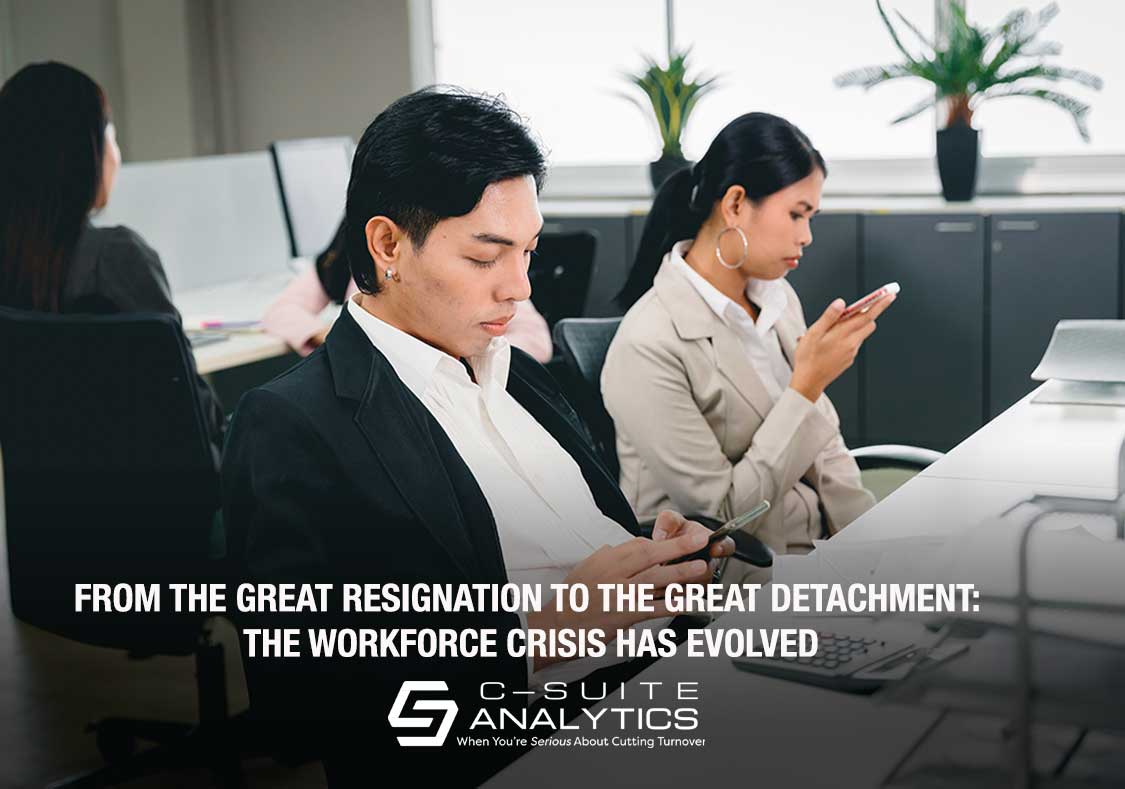
We thought “The Great Resignation” might be temporary – a symptom of post-pandemic disruption. Instead, it became something deeper: The Great Detachment.
Fewer people are quitting now, but more are quietly checking out. U.S. engagement has dropped to its lowest level in a decade, with only 31 percent of employees engaged and 17 percent actively disengaged.[i] And though monthly quits have fallen to around 3.2 million[ii], half of employees still say they are watching or actively seeking new jobs.[iii]
The resignation wave may have crested, but the detachment tide is still rising. To lead through it, managers must understand why this is happening and how to take ownership. Here are ten forces that turned a short-term labor shock into a long-term mindset shift.
1. Cultural Shifts That Rewired Worker Expectations
Movements like #MeToo and racial-justice protests permanently changed how people expect to be treated at work. Employees no longer tolerate toxic leaders or inequitable systems. They want psychological safety and transparency, and will quietly disengage if they don’t get it.
2. Pandemic Aftershocks and the Meaning-of-Work Reckoning
The pandemic caused millions to rethink priorities. Even as routines returned, the existential question, “What am I working for?”, remains. That question didn’t vanish with vaccines; it’s now woven into every retention challenge.
3. Women and Caregivers Still Demand Flexibility
Women left the workforce in record numbers in 2021, and while many returned, flexibility has become a permanent expectation. Organizations that treat flexibility as a perk instead of a core policy are watching women, and their discretionary effort, drift away.
4. Entrepreneurship and the Freedom Factor
Entrepreneurship surged by 24 percent during the Great Resignation[iv], and the spirit hasn’t faded. Side hustles and independent work continue to redefine what “job security” means. Detachment thrives when employees feel trapped by bureaucracy rather than inspired by purpose.
5. Retirements Reshaped the Labor Market
More than 2 million excess retirements during and after the pandemic created permanent knowledge gaps.[v] Younger employees have stepped in, but without the mentoring and trust networks retirees once provided, many feel untethered from institutional purpose.
6. A Shrinking Labor Pool
America’s population growth has slowed to historic lows. The labor force participation rate remains about 1 percentage point below pre-pandemic levels[vi], and immigration shortfalls have compounded the strain. Fewer workers mean higher pressure on the ones who remain, and higher burnout risk.
——
Further Reading: The Workforce Crisis Just Got Worse: Immigration, Retention & The Future of Work
——
7. Global Talent Declines and “Toxic Politics”
The United States still struggles to attract global talent at pre-2016 levels. High-skilled visas have not rebounded, and international researchers and clinicians continue to cite political and cultural polarization as reasons to work elsewhere. Detachment isn’t only emotional, it’s demographic.
8. The Lingering Human Toll of the Pandemic
Beyond the tragic loss of life, the pandemic altered how workers view health, risk, and loyalty. “Workplace safety” now means both physical and psychological safety. When leaders ignore that evolution, employees disengage, not necessarily out of defiance, but self-preservation.
——
Further Reading: Young Worker Safety Perceptions and Supervisor Trust
——
9. An Overabundance of Options
Even today, over 8 million job openings remain across the U.S. economy.[vii] Hybrid and remote work expanded the map of opportunity. Detachment accelerates when employees feel they always have somewhere else to go, without ever having to leave home.
10. Generational Power and the Detachment Mindset
Millennials and Gen Z now make up more than half of the workforce, with millennials alone reaching 75 percent by 2025.[viii] These workers are redefining success around fulfillment and flexibility, not loyalty. Their power in the labor market has created a new normal: people don’t quit because of bad companies, they detach because of bad leadership.
The Permanent Shift: From Turnover to Trust
The Wall Street Journal once warned that labor shortages might be “permanent.”[ix] Three years later, we see the deeper permanence: employees’ expectations of leadership have changed forever. The Great Detachment is less about people leaving jobs and more about them losing faith in leaders.
Workforce clouds will stay dark until organizations rebuild trust one manager at a time. Those who measure and manage that trust will out-recruit, out-retain, and out-perform everyone else.
Let’s make The Great Detachment our wake-up call – not our new normal.
The Bottom Line
That’s why the core principle of my new book, Targeting Turnover: Making Managers Accountable to Win the Workforce Crisis, is simple but urgent: Retention is a manager-accountability issue.
Turnover doesn’t start in the boardroom, it starts in the relationship between an employee and their leader. The antidote to detachment isn’t another perk or pay bump. It’s trust, conversation, and connection.
Read Targeting Turnover: Making Managers Accountable to Win the Workforce Crisis. It connects the dots from workforce math to line-leader accountability, with the how-to for embedding Stay Interviews and Finnegan’s Arrow. Available in e-book, audio, and paperback wherever books are sold – including Amazon, Barnes & Noble, and BookPal for group sales.
[i] HR Dive. (2024, June). U.S. employee engagement falls to 10-year low. https://www.hrdive.com/news/us-employee-engagement-falls-to-10-year-low/737270
[ii] Bureau of Labor Statistics. (2025, May). Job openings and labor turnover summary. U.S. Department of Labor. https://www.bls.gov/news.release/jolts.nr0.htm
[iii] Gallup. (2024, August). Employee turnover: Preventable but often ignored. Gallup Workplace. https://www.gallup.com/workplace/646538/employee-turnover-preventable-often-ignored.aspx
[iv] U.S. Census Bureau. (2024). Business formation statistics (BFS). https://www.census.gov/econ/bfs/
[v] Federal Reserve Bank of St. Louis. (2023, March). Excess retirements during the pandemic era. https://research.stlouisfed.org/publications
[vi] Pew Research Center. (2024). Trends in U.S. labor force participation and demographics. https://www.pewresearch.org
[vii] Bureau of Labor Statistics. (2025, May). Job openings and labor turnover summary. U.S. Department of Labor. https://www.bls.gov/news.release/jolts.nr0.htm
[viii] EY. (2024). Workforce demographic report 2024. Ernst & Young Global Limited. https://www.ey.com
[ix] Wall Street Journal. (2022, November). Economists warn labor shortage may be permanent. https://www.wsj.com
Related Posts