Keeping poor performers won’t protect your team, it drives away your top talent. Learn how reducing turnover restores accountability and strengthens performance.
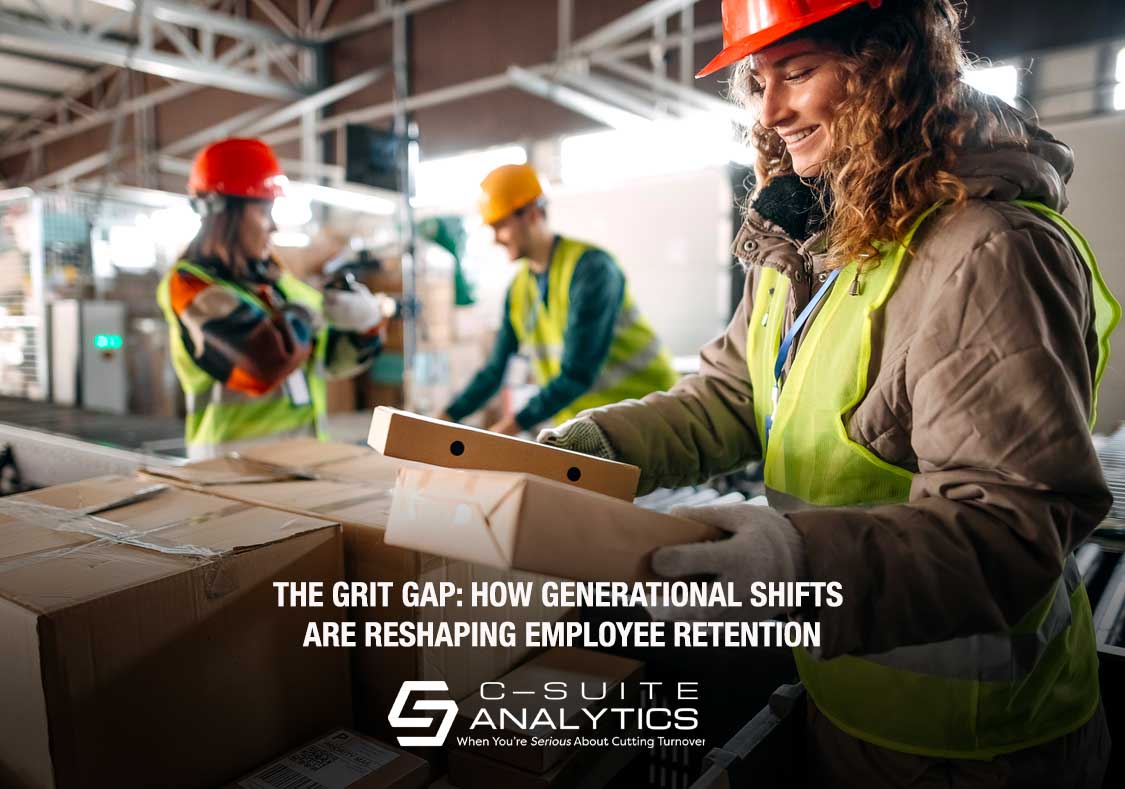
The GRIT Gap: How Generational Shifts Are Reshaping Employee Retention
We’ve all known someone who learns a new word and then obnoxiously repeats it over and over, like they suddenly discovered wisdom. This holiday season, I’m that guy. And the word is GRIT.
It’s not a new word, of course, but it was made golden as the title of Angela Duckworth’s 2016 bestseller. I bought the book early and have resurrected it many times since, tossing it into my travel bag for business trips. Duckworth, now a professor at the University of Pennsylvania, opens with a story about her father – far from flattering – who repeatedly told young Angela that she was “no genius.” Years later, as he neared the end of his life, she replied, “In the long run, Dad, grit may matter more than talent.”
GRIT Beats Talent
Duckworth defines grit as the power of passion and perseverance. Take her “How Gritty Are You?” assessment on page 55 and you may find it humbling. Her opening story about West Point’s rigorous admissions standards and startling drop-out rate is even more revealing. It’s where she demonstrated to West Point leadership that the single best predictor of cadet success was not talent, test scores, or intelligence – it was GRIT. The willingness to push, persist, and stay the course.
——
Further Reading: Young Workers, “Grit”, and New-Hire Turnover
——
Grit, Generations, and the Workforce Crisis Ahead
In my new book, Targeting Turnover, I explore how GRIT shows up differently across generations – especially as 30 million baby boomers, a cohort known for their grit, exit the workforce. Some of the facts include:
- Gallup’s reporting that employee engagement has reached an 11-year low, and the drop has been particularly acute among remote, hybrid and younger workers.[i]
- That younger workers are more likely to ghost job interviews and first days or work.
- Terms like “quiet quitting” and “work your wage” are new to our daily lexicon.
- That fewer young workers want the additional responsibilities that come with promotions[ii]
- The American Psychiatric Association reporting that over half of young professional workers said they needed mental health help in the past year.[iii]
- That record numbers of young adults are living with their parents[iv].
- And the pandemic’s impact on school children has been devastating as test scores are substantially down[v] and absenteeism has nearly doubled.[vi]
And perhaps most consequential: scientists link America’s sharply declining birthrate to the rise of smartphones beginning in 2011. As especially young people turned inward – toward apps, content, and digital connection – both romantic relationships and marriages declined, and with them the number of children being born.
—–
Further Reading: The Workforce Crisis Just Got Worse: Immigration, Retention & The Future of Work
—–
The Bottom Line of Young Worker Wanderlust
Baby boomers are taking with them their “just a few jobs for life” mindset – and history makes clear that younger generations have always stayed with employers for far shorter periods of time. This reality predicts continued pressure on retention for years to come.[vii]
Average Length of Employment by Generation
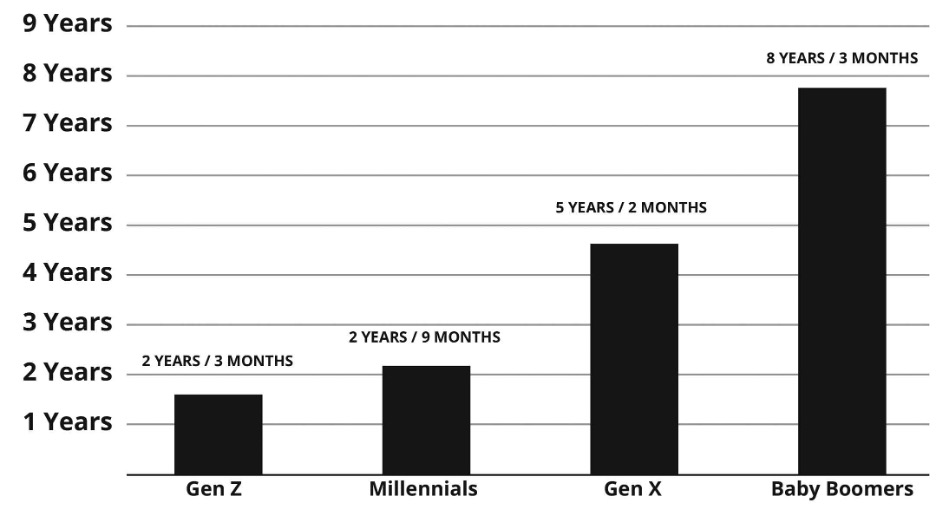
Source: Permission to reproduce. Career Builder published data.
Our Targeting Turnover weekly newsletter and same-named book share a deliberately focused intention: to help you improve employee retention and, by extension, your organization’s bottom line. All the data above leads to one undeniable conclusion:
It is far more cost-effective to retain the good workers you already have than to lose them and start again.
Why GRIT May Matter More Than Talent in 2026
To dive deeper into how GRIT, trust, generational shifts, and manager accountability intersect to shape today’s retention crisis, explore Targeting Turnover: Make Managers Accountable to Win the Workforce Crisis. It is a research-backed, action-ready guide for leaders who want better retention, stronger teams, and measurable results.
Get your copy of Targeting Turnover and equip your managers with the tools to win the workforce crisis. Available in e-book, audio, and paperback wherever books are sold – including Amazon, Barnes & Noble, and BookPal for group sales.
[i] Jim Harter, “US Engagement Hits 11-Year Low,”, Gallup, April 10, 2024 https://www.gallup.com/workplace/643286/engagement-hits-11-year-low.aspx#:~:text=In%20the%20latest%20reading%2C%20from,than%202020’s%20high%20of%2036%25.
[ii] Tim Paradis, “Gen Zers Are Saying ‘No Thanks’ to Promotions For Reasons That Go Beyond Money,” Business Insider, November 8, 2023: https://www.businessinsider.com/gen-z-rejects-promotions-management-roles-traditional-corporate-ladder-2023-11
[iii] Jean M. Twenge, “Have Smart Phones Destroyed A Generation, The Atlantic, September 2017; https://www.theatlantic.com/magazine/archive/2017/09/has-the-smartphone-destroyed-a-generation/534198/
[iv] Jean Sahadi, “Many parents say they are still financially subsidizing their adult children,” CNN Business, January 25, 2024; https://www.cnn.com/2024/01/25/success/parenting-adult-children-living-home/index.html
[v] Tom Swiderski and Sarah Crittenden Fuller, “Student GPA and test score gaps are growing – and could be slowing pandemic recovery,” Brookings, November 6, 2023; https://www.brookings.edu/articles/student-gpa-and-test-score-gaps-are-growing-and-could-be-slowing-pandemic-recovery/#:~:text=At%20every%20letter%20grade%2C%20post,peers%20who%20earned%20an%20A.
[vi] Alec MacGillis, ”Skipping School: America’s Hidden Education Crisis,” ProPublica, January 8, 2024;
[vii] “Millennials or Gen Z: who’s doing the most job-hopping,” Career Builder blog for job-seekers; https://www.careerbuilder.com/advice/blog/how-long-should-you-stay-in-a-job
Related Posts