
Angela Duckworth’s research on GRIT reveals why passion and perseverance – not talent –predict workplace success. As baby boomers retire and younger workers enter with lower grit, engagement drops, and retention challenges intensify. Learn why retaining your best employees matters more than ever.
Does Pay Matter More for Some Jobs Than Others?

Let’s make clear up front that the top reason employees stay or leave, or engage or disengage, is how much they trust their immediate, first-line supervisor. But pay will always matter, too.
Today we’ll look at who it matters to most, drawing from an excerpt of my new book, Targeting Turnover. This is thoughtful, research-driven work, and I think you’ll find it fascinating.
A Job, a Career, or a Calling?
Yale professor Dr. Amy Wrzesniewski has studied how individuals identify with their work and found three distinct mindsets: job, career, and calling. Each one shapes how much compensation matters.
- JOB: A job provides pay, benefits, and perhaps some social perks. It’s primarily about earning a paycheck. People in this category are more invested in their lives outside of work; the job funds what they love to do beyond it.
- CAREER: A job is something you do for others; a career is what you build for yourself. Career professionals still work for the paycheck, but they’re also motivated by advancement and recognition.
- CALLING: People who see their work as a calling feel a deep alignment between what they do and who they are. They find meaning and personal fulfillment in their work itself.[i]
You likely know people who fit each category. Dr. Wrzesniewski emphasizes that all three are honorable – dissonance arises only when we find ourselves misaligned. If you simply want to do good work and go home, the “job” mindset can bring satisfaction. But if you crave deeper purpose and find yourself in a purely transactional environment, frustration follows.
Compensation, of course, plays a role in all three. But it’s more central for some than others. Those with a career mindset often chase higher pay and promotions, while those with a calling are driven by meaning and impact.
For instance, social service agencies might seek people motivated by a sense of purpose, while investment banks may thrive by attracting career-driven employees who compete for higher earnings.
So ask yourself: which of these three work contexts best fits your organization’s highest-turnover roles?
—–
Further Reading: Are You Hiring for a Calling or a Job? It Impacts Retention
——
The Impact on Minimum-Wage Workers
We often classify U.S. workers as exempt vs. non-exempt, or white collar vs. blue collar, but minimum-wage jobs stand apart. Many of these roles offer limited advancement opportunity and are assumed to be “just for the money.”
But that assumption misses something vital.
UCLA professor Mike Rose, in his book The Mind at Work, explored the intelligence and craft of America’s working class, from waitresses to welders. His research challenges the idea that manual jobs are low-skill.
Here’s how one hair stylist, Sharon, described her approach to cutting hair:
“You’ve got to add up all these pieces of the puzzle, and then at the end you’ve got to come up with a thought, OK, it’s gotta be this length, it’s gotta be layered here, it’s got to be textured there, it can have a fringe, it can’t have a fringe, you know, so the thought process goes…It’s not like we just start cutting. By the time I take my client to the shampoo bowl, after the consultation, I already have a little road map as to how I’m going to cut this haircut.”[ii]
It’s hard not to see Sharon’s work as a calling.
——
Further Reading: Why Stay Interviews Q2 is Deceptively Simple – and Powerful
——
Dr. Wrzesniewski found the same potential among hospital custodians.
One, named Luke, cleaned a patient’s room a second time so the patient’s father, who had missed the first cleaning, could see it done. Another, Carlotta, changed the artwork on the walls of comatose patients’ rooms so that when they woke, they would see something new.
Carlotta explained:
“I enjoy entertaining patients. That’s what I enjoy the most. And that is not really part of my job description. But I like putting on a show for them, per se. Dancing if there is a certain song on, I get to dance and if a talk show is on, I get to talk about that talk show or whatever. That’s what I enjoy most. I enjoy making people laugh.”[iii]
Their stories remind us that meaning and pride can exist at any pay level. Even among minimum-wage workers, pay alone rarely drives engagement or retention.
The Metrics That Matter Most
I wrote my book, Targeting Turnover: Making Managers Accountable to Win the Workforce Crisis, after years of waiting to see what challenge would define our post-pandemic workforce. What I found had little to do with COVID-19. It was demographic.
Economists have long warned about the twin forces of mass baby-boomer retirements and declining birthrates – but the numbers hadn’t been fully translated into real workforce math. After months of digging and direct conversations with the U.S. Census Bureau, I uncovered the full picture.
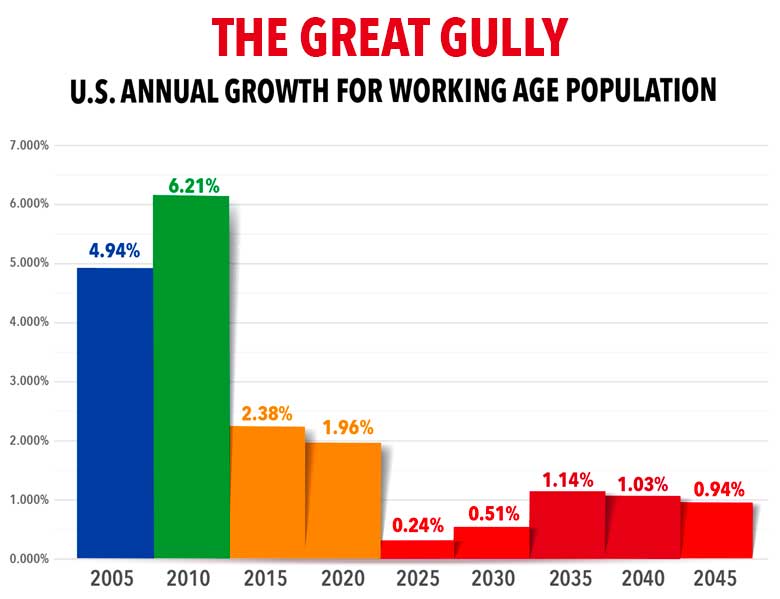
Here it is in one sentence:
The U.S. will add only one-fifth as many working-age adults going forward as it has in the past.
That shift begins now, in 2025.
Every employee who quits today isn’t just a vacancy – it’s a labor-market loss that may never be replaced. The countries and companies that retain talent will win. Those that don’t will fall behind economically.
Perks won’t fix this. Slogans won’t either.
The only sustainable solution is leadership accountability – holding managers responsible for the experiences they create and the trust they build.
That’s where Targeting Turnover comes in: connecting engagement, retention, and accountability into one actionable model for leaders at every level.
Connect engagement, retention, and accountability in your organization.
Read Targeting Turnover: Making Managers Accountable to Win the Workforce Crisis.
Available in e-book, audio, and paperback wherever books are sold – including Amazon, Barnes & Noble, and BookPal for group sales.
[i] Katharine Brooks, “Job, Career, Calling: Key to Happiness and Meaning at Work?” Psychology Today, June 29, 2012; https://www.psychologytoday.com/us/blog/career-transitions/201206/job-career-calling-key-happiness-and-meaning-work
[ii] Mike Rose, The Mind At Work, New York: Penguin Books, 2004
[iii] Barry Schwartz, Why We Work. New York: Simon & Schuster, TED Books, 2015
Related Posts