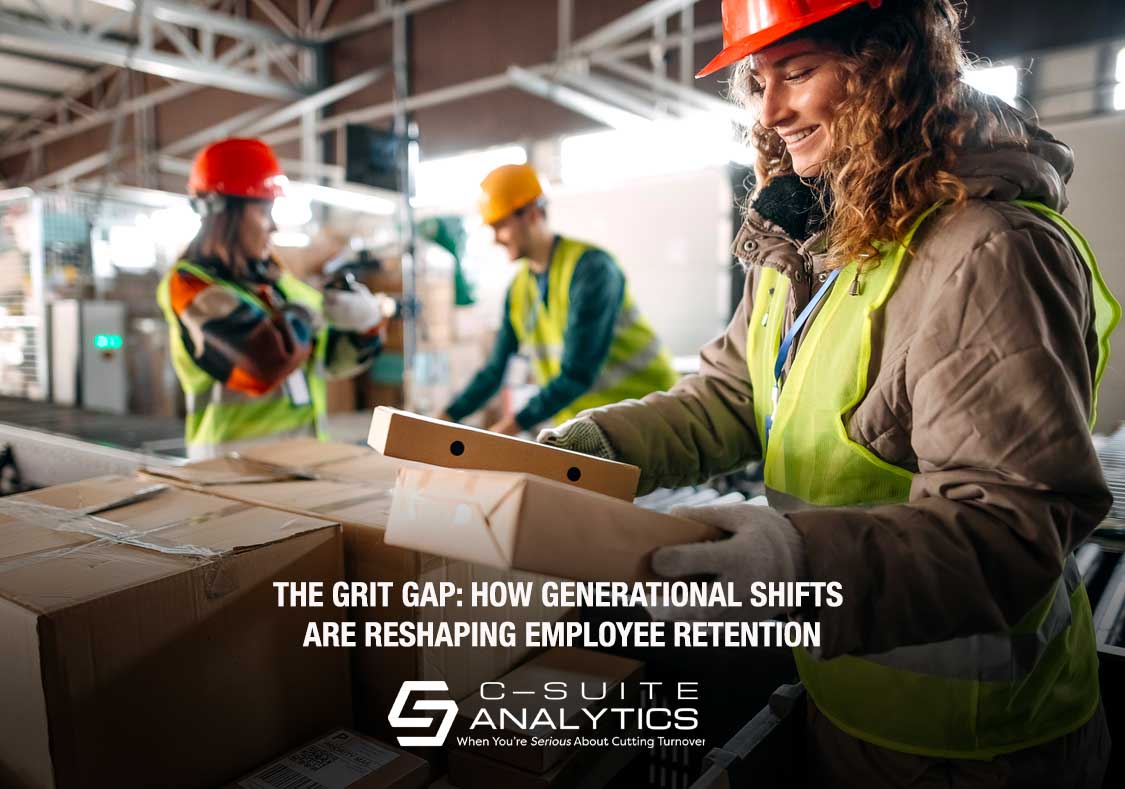
Angela Duckworth’s research on GRIT reveals why passion and perseverance – not talent –predict workplace success. As baby boomers retire and younger workers enter with lower grit, engagement drops, and retention challenges intensify. Learn why retaining your best employees matters more than ever.
Stop Chasing “Fuzzy” Engagement Scores – Start Driving Accountability

Employee engagement has always been a fuzzy concept that usually generates fuzzy metrics. Most organizations conduct an engagement survey once or twice a year and assume the results capture how committed their employees are. But a one-time snapshot on a random Thursday doesn’t reflect how employees feel about their jobs every day – and leaders too often mistake survey scores for true engagement.
Engagement Scores vs. Real Productivity
There’s no question that engagement matters. In fact, employee engagement impacts productivity more than pay, benefits, or other tangible perks. Gallup has long called the link between engagement and performance “substantial and highly generalizable,” showing top-quartile organizations consistently outperform those at the bottom on productivity, safety, quality, and retention. MIT Sloan found that companies with consistent profit growth had more engaged employees, while disengaged workforces correlated directly with flat or negative growth.
These correlations should make CFOs salivate. After all, employees don’t work harder because companies are profitable – companies are profitable because employees are engaged. Yet too often, organizations spend more time debating survey scores than implementing strategies that improve trust, performance, and retention.
——
Further Reading: The Workforce Crisis Solution: 4 Ways to Turn Engagement into Retention
——-
Why Engagement Surveys Fail Leaders
Engagement surveys, when used well, can point to areas for improvement. But here’s where most organizations go wrong:
- Data without accountability. Leaders receive their team’s survey results, but no one holds them responsible for acting on them.
- Questions that miss the mark. Surveys don’t ask enough about trust in the immediate supervisor – the single biggest driver of engagement.
- Dangerous comparisons. Benchmarking against other companies lowers ambition and excuses poor performance.
- Activity over outcomes. Engagement plans filled with events and perks don’t move the needle on productivity or retention.
The result? Leadership teams comfort themselves with “middle of the pack” scores instead of demanding improvement.
What Works: Engagement + Accountability
In Targeting Turnover, I make the case that surveys alone will never solve disengagement. The missing link is accountability. Leaders must be measured and held responsible for improving engagement, just as they are for sales, service, or safety.
That means:
- Every leader, at every level, receives their team’s engagement data.
- At least one-third of survey questions focus on trust, recognition, communication, and coaching.
- Leaders create improvement plans centered on relationships, not just events or free food.
- Performance is tracked across surveys. Leaders who don’t improve are coached – and if they still can’t deliver, they’re replaced.
No CEO would tolerate a manager who consistently misses sales goals. Engagement, which drives productivity and retention, should be treated the same way.
——
Further Reading: Two Ways to Cut Turnover. Only One Will Always Work.
——-
Beyond Surveys: Stay Interviews
The most effective way to link engagement with retention is through Stay Interviews. Instead of guessing at what employees need, managers ask them directly: What will keep you here? What might cause you to leave? What can I do to make your job better?
When paired with accountability, Stay Interviews as part of Finnegan’s Arrow with goals, forecasts, and consequences, is proven to transform leaders. They stop managing by assumption and start managing by listening. And when executives enforce accountability for engagement and retention – backed by the undeniable data linking both to productivity – they finally move from fuzzy metrics to real outcomes.
Final Word: The Workforce Crisis Won’t Wait
The U.S. is running out of workers. Thirty million Americans are reaching retirement age this decade, and the only lever companies truly control is retention. Engagement surveys are only useful if they lead to accountability and action. Without that, they’re just another fuzzy metric in a world that now demands hard results.
The Playbook for Making Managers Accountable
If you need a playbook for making managers accountable – not just aware – see my new book Targeting Turnover: Making Managers Accountable to Win the Workforce Crisis. It connects the dots from workforce math to line-leader accountability, with the how-to for embedding Stay Interviews and Finnegan’s Arrow.
Available in e-book, audio, and paperback wherever books are sold – including Amazon, Barnes & Noble, and BookPal for group sales.
Related Posts